
Case Study:
Build, Hand Off, Scale. A Co-Founder’s Playbook at Sun Basket
Overview: Between 2014 and 2019, Sun Basket grew from two founders to roughly 1,800 employees and $300M in annual recurring revenue. George's role as a co-founder followed a pattern: find the gap the business couldn't yet fill, build the function from scratch, hand it to a dedicated leader, and let that leader take it further than he could have alone. Then he moved on to the next critical gap. Across three growth phases, what he handed off grew more ambitious: first a team, then a way of working, then a creative engine.
The insight: The handoff, not the building, is what made growth possible. A function stays founder-sized as long as a founder is still owning it. What made each handoff work was transferring “the why” along with the job.
The cycle:
Build. Spot what the business needs and stand it up quickly, usually without a playbook.
Hand off. Recruit or develop a leader, transfer the why along with the how, and step back.
Scale. The new leader professionalizes and grows the function, while George moves to the next gap.

Phase 1: Establishing Foundations (From $0 to $100M)
Handing off a team. The first handoff was the most concrete: a function George built by hand, passed to a leader who could grow it far beyond its founder-run size.
Build: In the early days, George took on whatever the business needed: brokering a culinary partnership with chef Tyler Florence, building the first creative team for recipes, photography, video, and customer communications, and standing up Sun Basket's first customer service team, about 10 people running a Monday-to-Friday operation.
Hand off: George hired an experienced customer service leader to take the function forward, and stayed involved where he added the most: making sure every customer interaction sounded like Sun Basket and reflected its values.
Scale: Under that leader, the team grew to more than 100 people, with integrated support systems and offshore coverage, and became an award-winning customer service organization.
Image: George celebrates the packing and shipping of the first pallet of boxes with his chilly colleagues Amy, Justine, and Daniel.
Phase 2: Scaling (Growing to $200M)
Handing off a way of working. As the company grew, the bottleneck wasn't any single function. It was the founder-driven habits connecting them. This phase replaced heroics with processes the whole organization could run.
Build: As growth accelerated, George led the company's corporate real estate expansion, overseeing five headquarters and test kitchen moves, and recruited the executives who would lead marketing, food manufacturing, and print publishing. He also hired senior editorial talent, including James Beard nominees and Food & Wine veterans.
Hand off: In this phase, the handoff was from heroics to systems. The "just get it done" approach that worked at the start couldn't continue to carry a company this size. George facilitated the connections between functions, such as recipe development and manufacturing as Sun Basket integrated its first Enterprise Resource Planning (ERP) system, and built the processes that enabled teams to work together without a founder brokering every exchange.
Scale: With repeatable processes in place, Sun Basket grew to a production footprint of roughly 250,000 square feet across three facilities in California, Illinois, and New Jersey.
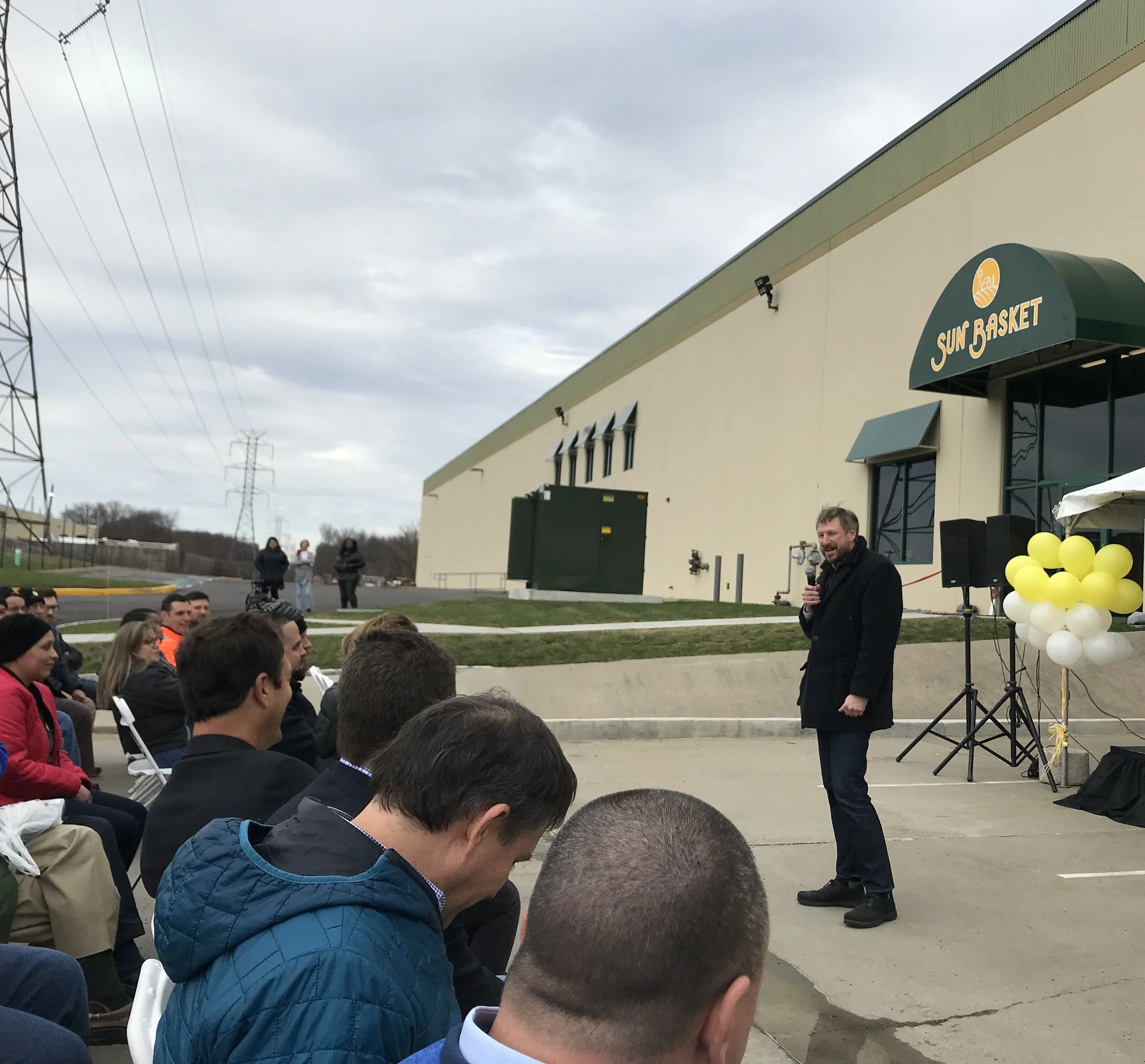
Image: George shares a silly joke at the opening of Sun Basket’s production facility in New Jersey.

Phase 3: Brand and Communication (From $200M to $300M)
Handing off a creative engine. The final handoff turned creative work, which had depended on a few people's instincts, into a studio with the structure and leaders to keep producing at scale for marketing, brand, and product.
Build: George built Sun Basket Studios, an in-house creative agency, to make materials for paid online marketing faster and more effective. He also led the creation of The Sun Times, a weekly magazine that replaced individual recipe cards, and conducted in-home consumer interviews that shaped product and UX decisions.
Hand off: The Studios gave creative work a structure and a project management process that didn't depend on one person to move each piece forward. Team members grew into leaders of their own disciplines, from photography to recipe writing to video production.
Scale: The Studios produced 1,800+ recipes, 600+ articles, and a weekly Sun Times magazine with millions of issues a year that also cut collateral packing errors to near zero. (See the Studios case study.)
Image: Sun Basket is a weekly home delivery with recipes and fresh, prepped ingredients for three delicious and nutritious dinners.
Results:
$300M+ in annual recurring revenue and profitability
Customer service, cross-functional processes, and creative each built, handed off, and grown well beyond what one founder could run
A work process George now brings to leaders facing similar challenges
Takeaway for founders: If you're still running the functions you built, the question isn't whether you can keep doing it. It's whether those functions, and the business, can grow while you're still holding them.